
Cement Repair With Precision Annular Isolation And APS Extends Production In A Mature Depleted Well
Increasing water production from a mature, depleted and highly deviated gas well, caused by poor cement behind the liner, had severely limited output. Interwell combined an Anchored Production Straddle with perf-less CannSeal ZonalSeal to restore zonal isolation rigless on e-line, stopping the water and significantly increasing gas production.
Year
Region
Challenge
An operator in Australia was experiencing increasing water production from a mature, depleted and highly deviated gas well (inclination greater than 60°), which had severely limited its output. Poor cement behind the 7” liner had resulted in a loss of zonal isolation, allowing water to flow behind the liner, bypass previously installed tubing plugs and re-enter the wellbore through open perforations. Earlier measures had initially reduced water production, but rates increased again within weeks, and recovery of the existing plugs was considered unlikely. The operator established a Water Shut Off (WSO) objective to stop the unwanted flow behind the liner and restore zonal isolation.
Solution
After assessing multiple intervention options, the operator selected an Interwell WSO solution combining an Anchored Production Straddle (APS) with CannSeal ZonalSeal. This was the first use of the combination by Interwell and the first CannSeal deployment in Australia. CannSeal was preferred because its engineered epoxy resists slumping and segregation, maintaining placement integrity in highly deviated wellbores. Instead of using small charges to create access through the pipe, the standard system was converted to a perf-less (non-explosive) configuration, using the APS to place epoxy outside existing perforations, punched or drilled holes, pre-drilled liners or slotted liners.
→ Anchored Production Straddle (APS) with injection sub
→ Annular Isolation – CannSeal ZonalSeal, perf-less (non-explosive) configuration
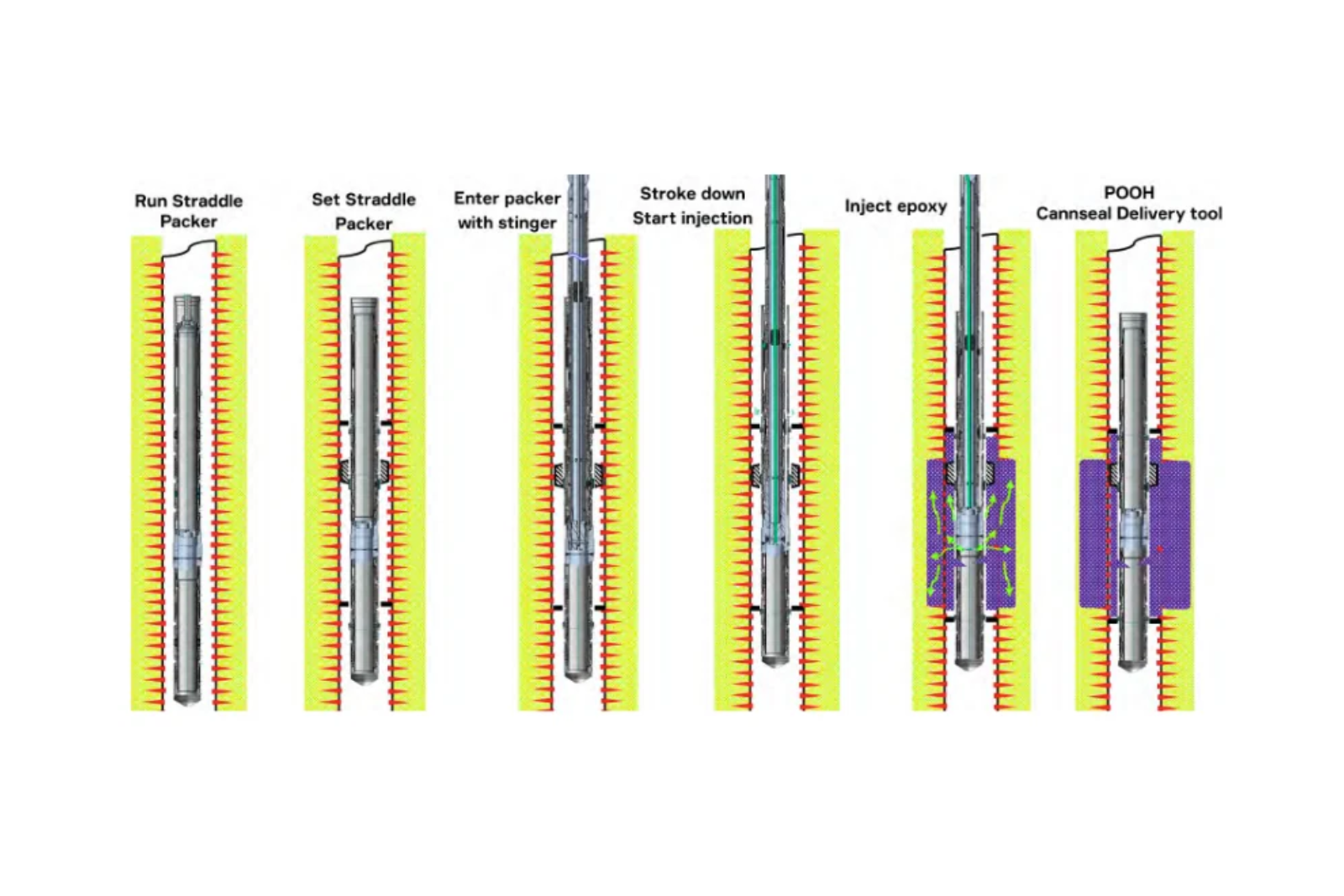
The WSO was completed rigless on e-line: the APS was installed first, followed by a single epoxy injection. A System Integration Test (SIT) at Interwell’s facility in Norway confirmed the required epoxy volume and injection methodology, engineered to the specific well.
In Run 1, the APS, fitted with an injection sub and pre-installed receptacle, was set across the lower production perforations, providing blank pipe so epoxy could only travel outwards into the annulus. In Run 2, the CannSeal delivery tool was stung into the receptacle and ultra-high-viscosity epoxy was injected through check-valved ports, out through the existing perforations and into the annulus, sealing the water pathway behind the liner.
Injection pressure and volume were monitored in real time, with strict volume control. Approximately 30L of epoxy achieved a calculated 2m annular isolation behind the liner.
Value Created
Following the CannSeal deployment and well testing, the well flowed successfully without water, with a significant increase in production compared with its previous production period.
By combining APS with CannSeal ZonalSeal, Interwell addressed both flow paths in a single treatment design. The straddle isolated the perforations inside the tubing, while the epoxy sealed the water pathway behind the liner, where tubing plugs alone had been unable to stop the flow. The perf-less, non-explosive configuration meant no new perforations were needed, and the approach worked around previously installed plugs that could not be recovered.
Delivery also required careful logistics planning. The 6m epoxy canisters were transported from the UAE to Australia in refrigerated containers below -20°C, with continuous power maintained throughout the journey before offshore mobilisation.
As the first use of this combination by Interwell, and the first CannSeal deployment in Australia, the results demonstrate that APS combined with CannSeal ZonalSeal is an effective and practical WSO solution for mature, depleted and highly deviated wells where poor cement has led to lost zonal isolation behind a liner.
Key Capabilities:
→ First use of perf-less (non-explosive) CannSeal ZonalSeal combined with APS
→ First CannSeal deployment in Australia
→ Placement integrity of ultra-high-viscosity epoxy in highly deviated wells (>60°)
→ Controlled placement of epoxy behind existing production perforations
→ Rigless e-line: APS run, then a single epoxy injection confirmed through System Integration Test (SIT)
Benefits:
→ Restores zonal isolation behind the liner
→ Stops water bypassing existing tubing plugs
→ No explosives or new perforations required
→ Significant production uplift, extending the life of a late-life well
Key Applications:
→ WSO where poor cement has led to lost zonal isolation
→ Epoxy placement outside existing perforations, punched or drilled holes, pre-drilled liners or slotted liners
→ Wells where previous plugs are bypassed or cannot be retrieved
→ Ultra-high-viscosity sealant placement in high-angle or horizontal wells

